 By Admin
 AI
 4 Min Read
 Nov 13, 2026
Early attempts at restaurant automation were largely confined to wheeled cylindrical kiosks that chimed cheerful tunes while rolling along magnetic floor strips. While novel, these wheeled carts frequently jammed in tight aisles, could not open doors, and required human waitstaff to load and unload plates.
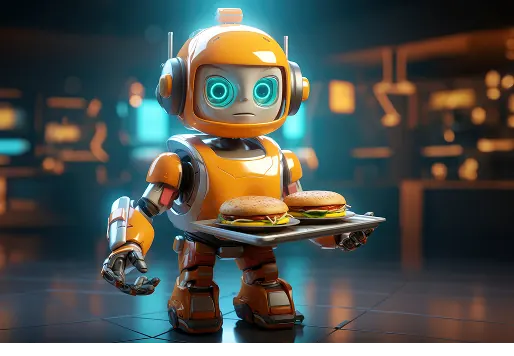
The deployment of compact, purpose-built humanoid service robots—such as the latest systems from Richtech, Figure, and Unitree—represents a quantum leap in commercial dining automation. Equipped with high-torque brushless actuators, stereoscopic depth cameras, and five-fingered silicone grippers, these machines seamlessly manipulate standard restaurant trays, carry hot dishes without spilling, and deliver meals directly to tabletop coordinates.

Vision-Language-Action Models and Real-Time Spatial Navigation
The technological breakthrough powering modern service robots is the maturation of Vision-Language-Action (VLA) models. Unlike hardcoded industrial automation scripts, VLA architectures enable the robot to understand natural language instructions from kitchen chefs—such as 'Deliver the smashburger basket to table seven and watch out for the toddler near the entrance'—and translate that intent into continuous motor trajectories.
Using 360-degree LiDAR and neural radiance mapping, the robot maintains an active volumetric map of the dining room. If a patron unexpectedly pushes back their chair or drops a napkin, the robot’s perception pipeline recalibrates its path in less than 15 milliseconds, ensuring safe, zero-contact human coexistence.
- Dynamic Tray Balancing: Multi-axis inertial measurement units (IMUs) compensate for liquid slosh and sudden floor irregularities in real time.
- Direct POS Integration: Robots interface directly with Toast, Square, and Oracle Micros Kitchen Display Systems (KDS) for automated dispatch.
- HACCP Food Safety Compliance: Food-grade antimicrobial silicone coatings and UV-C sanitization cycles between meal deliveries.
- Collaborative Kitchen Support: Capable of assisting with repetitive kitchen tasks, including fry-basket retrieval, burger assembly, and dish clearing.
“Commercial kitchens are among the most chaotic physical environments on earth: hot surfaces, wet floors, and erratic human foot traffic. When a robot can balance two hot burger trays and navigate a crowded dining room safely, embodied AI has crossed the threshold.”— Elena Rostova, VP of Robotics at Apex Automation

Solving Chronic Hospitality Deficits While Enhancing Guest Experience
With restaurant operators worldwide grappling with persistent kitchen and front-of-house labor shortages, autonomous service robots provide crucial operational buffer. Rather than replacing human hospitality, the robots shoulder the physically punishing aspects of food running and dish hauling, freeing human staff to focus on guest hospitality and tableside rapport.
As fleet leasing costs decline to parity with entry-level wages, autonomous food service robotics is transitioning from an experimental marketing novelty into standard operational infrastructure across the hospitality industry.
Senior Technology Editor
Steve Jones covers cutting-edge artificial intelligence, robotics, multimodal foundation models and edge neural silicon for Technoveda. He analyzes breakthrough technical research and industry deployments to deliver actionable insights for global readers.





 Previous Story



 Technology
 Business Tech
 Smartphones
 Travel Tech
 Health Tech
 Tech Careers

Comments (2)
Alex Mercer
Nov 14, 2026 at 10:15 AMThe speed at which these AI systems are maturing from basic text completion to verified, grounded multimodal reasoning is astounding. The practical efficiency gains in research and engineering workflows are undeniably real.
Devin Patel
Nov 14, 2026 at 11:42 AMAgreed! The shift toward low-power on-device inference is the real game-changer here. Privacy and latency were always the two major roadblocks holding enterprise and academic adoption back.