 By Admin
 AI
 4 Min Read
 Nov 11, 2026
For decades, athletic coaching in weightlifting, gymnastics, and sprinting relied heavily on the subjective eye of the coach. Even experienced trainers struggled to detect subtle 3-degree pelvic tilts, asymmetric bar dips, or microsecond velocity drops that signal impending soft tissue injury.
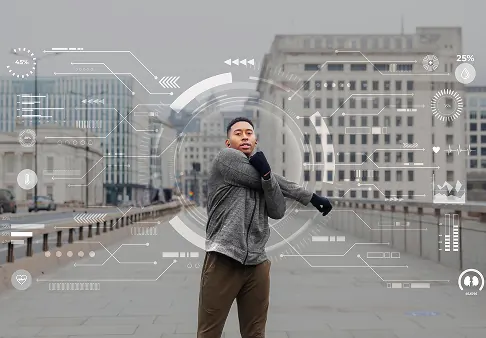
In 2026, markerless computer vision powered by deep neural networks has democratized biomechanical analysis. By processing 120-frame-per-second video streams directly on edge devices, AI vision models extract 3D kinematic skeletons with sub-millimeter precision, tracking 32 anatomical joints without requiring athletes to wear uncomfortable body markers.
Velocity-Based Training and Predictive Neuromuscular Fatigue
The cornerstone of modern strength conditioning is Velocity-Based Training (VBT). Rather than prescribing rigid repetition targets, AI algorithms measure the concentric velocity of barbell lifts in real time. If an athlete’s mean barbell velocity drops by more than 15% between repetitions, the system flags central nervous system fatigue.
By correlating bar trajectory, eccentric braking duration, and spinal extension angles, the AI coach signals an immediate set termination. This objective auto-regulation prevents overtraining syndrome, accelerates muscular hypertrophy, and virtually eliminates chronic lower-back and rotator-cuff trauma.
- Markerless 3D Skeletal Tracking: Analyzes joint angles, knee valgus collapse, and spine neutral alignment at 120 FPS using consumer cameras.
- Dynamic Bar Path Visualization: Overlays real-time trajectory curves and vertical displacement metrics to verify optimal lifting mechanics.
- Fatigue-Based Auto-Regulation: Automatically adjusts daily training volume based on neuromuscular velocity loss rather than predetermined reps.
- Asymmetry & Injury Alerts: Flags bilateral force imbalances between left and right limbs before compensatory orthopedic strain develops.
“We used to rely on retro-reflective markers and million-dollar motion capture labs to understand athletic movement. Today, a single smartphone camera powered by edge neural networks can diagnose ACL tear risks in the middle of a heavy squat set.”— Coach Brian MacIntyre, Head of Sports Science at Peak Human Performance

Empowering Grassroots Athletics and Rehabilitation
While professional sports leagues like the NFL, Premier League, and Olympic weightlifting federations were early adopters, the technology has rapidly migrated to commercial fitness centers and physical therapy clinics. High school athletes and recreational lifters now receive the same caliber of real-time movement feedback once exclusive to elite Olympians.
By transforming raw video feeds into actionable biomechanical intelligence, AI computer vision is ensuring that human physical achievement can reach new heights with unprecedented longevity and safety.
Biomedical Systems & Health Tech Fellow
Dr. Sarah Chen covers cutting-edge artificial intelligence, robotics, multimodal foundation models and edge neural silicon for Technoveda. He analyzes breakthrough technical research and industry deployments to deliver actionable insights for global readers.





 Previous Story


 Technology
 Business Tech
 Smartphones
 Travel Tech
 Health Tech
 Tech Careers

Comments (2)
Alex Mercer
Nov 14, 2026 at 10:15 AMThe speed at which these AI systems are maturing from basic text completion to verified, grounded multimodal reasoning is astounding. The practical efficiency gains in research and engineering workflows are undeniably real.
Devin Patel
Nov 14, 2026 at 11:42 AMAgreed! The shift toward low-power on-device inference is the real game-changer here. Privacy and latency were always the two major roadblocks holding enterprise and academic adoption back.