
 By Admin
 Products
 5 Min Read
 Nov 03, 2026
For software developers, data scientists, and creative professionals, screen real estate is productivity currency. Writing code while keeping terminal logs, API documentation, and staging browser environments simultaneously visible requires multiple monitors that traditionally anchor engineers to a physical office desk.
In late 2026, spatial computing hardware has crossed the crucial ergonomic threshold. Devices like the Spacetop G1 augmented reality laptop (a screenless laptop base paired with 85-gram AR glasses), Apple Vision Pro's ultra-wide Mac Virtual Display, and XREAL Air 2 Ultra allow professionals to spawn expansive multi-monitor workspaces anywhere they sit.
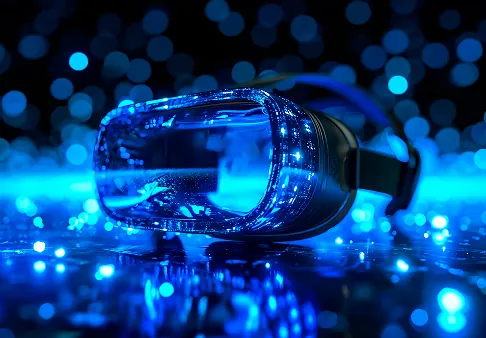
Micro-OLED Text Sharpness and Foveated Rendering
Early AR glasses suffered from low resolution that caused pixelated text, color fringing, and eye strain after 30 minutes of terminal coding. The breakthrough in 2026 hardware is Sony and BOE's 4K Micro-OLED silicon backplanes delivering 45 to 55 PPD (Pixels Per Degree) with 10,000-nit peak brightness.
Combined with 6-degree-of-freedom (6DoF) spatial tracking running on dedicated SLAM co-processors, virtual screens remain rock-solid in 3D physical space. When you turn your head to sip coffee, the virtual code window stays anchored exactly where you placed it, maintaining zero drift or jitter.
- Floating Multi-Monitor Canvas: Projects up to five customizable 4K curved displays floating in physical space without physical screens.
- 50 PPD Micro-OLED Clarity: Pin-sharp typography and dark-mode contrast eliminates eye fatigue during 8-hour coding sessions.
- All-Day Ergonomic Weight: Lightweight 80g to 120g frames distribute weight evenly across temple arms without nose pinch.
- Electrochromic Dimming Glass: Electronically tints external lenses from transparent ambient AR to opaque VR mode with one button.
“Carrying three physical 32-inch 4K monitors on a flight or into a coffee shop is impossible. Wearing lightweight AR glasses that project three curved 4K canvases floating in mid-air is sheer engineering magic.”— Alexandre Guibal, Lead Systems Engineer at CloudCore

The Verdict: The Future of Developer Workstations
While heavy mixed reality goggles remain better suited for gaming and short sessions, lightweight spatial AR glasses and screenless laptops have proven themselves as genuine desktop replacements.
For mobile developers and digital nomads who demand boundless multi-screen productivity without bulky physical monitors, spatial computing workstations represent the most transformative hardware upgrade of 2026.
Senior Hardware & Products Editor
Steve Jones is Technoveda’s Senior Hardware & Products Editor. With over a decade of experience testing and benchmarking consumer electronics, smart mobility systems, audiophile gear, and cutting-edge gadgetry, his rigorous laboratory reviews deliver actionable purchasing guidance for tech enthusiasts worldwide.





 Previous Review



 Business Tech
 Smartphones
 Travel Tech
 Health Tech
 Tech Careers


Comments (2)
Jordan Blake
Nov 14, 2026 at 11:30 AMFinally a review that delves deep into the hardware engineering and actual battery performance under real-world conditions rather than just reading off the spec sheet. Superb analysis!
Samantha Rivera
Nov 14, 2026 at 12:15 PMAgreed! The comparison testing between dedicated silicon and traditional architecture really highlights how fast consumer hardware is advancing this year.