 By Admin
 Products
 5 Min Read
 Nov 11, 2026
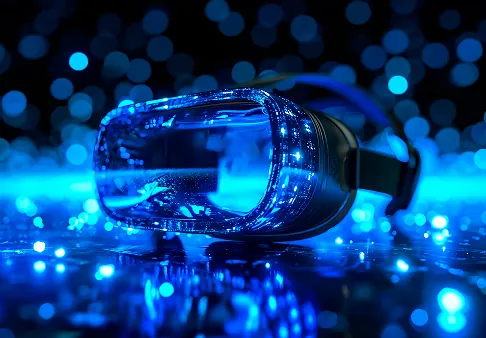
The primary obstacle preventing headsets from reaching true mass-market adoption has never been software or processing power—it has been physical ergonomics. Early virtual reality visors relied on heavy fast-switch LCD panels and thick Fresnel lenses that protruded inches from the face, causing significant neck fatigue.
A seismic hardware transition has matured across global supply chains: the combination of silicon-backed Micro-OLED (OLEDoS) microdisplays and folded pancake optical lenses. By packing over 3,500 pixels per inch onto postage-stamp-sized silicon wafers, manufacturers have shrunk the optical engine by more than 60%.

Tandem OLED Architecture and the 10,000-Nit Breakthrough
Historically, the Achilles' heel of pancake lenses was light inefficiency: as light bounces back and forth between polarized mirrors within the folded glass, over 80% of emitted photons are absorbed. To deliver acceptable brightness to human eyes, microdisplays had to be driven to extreme output levels.
Display powerhouses Sony and BOE have cracked this challenge with tandem two-stack RGB Micro-OLED architectures. By stacking two organic light-emitting layers in series, the panels achieve peak luminance exceeding 10,000 nits while cutting thermal power consumption in half, ensuring vivid HDR highlights and pitch-black contrast.
- Sub-250 gram visors: Slim optical engines allow headsets to weigh less than half of early first-generation spatial visors.
- 4K-per-eye clarity: Over 4,000 PPI eliminates pixelation, jagged lines, and the distracting screen-door effect entirely.
- Tandem emissive layers: Two stacked OLED diodes deliver double the optical brightness without accelerating burn-in.
- Edge-to-edge optical clarity: Aspherical pancake elements eliminate color fringing and peripheral chromatic aberration.

“Pancake optics folded the light, but micro-OLED delivers the photon density required to make pixels imperceptible. We are finally entering the sub-250g headset era.”
The Path to Mainstream Consumer Spatial Computing
As manufacturing yields improve at high-volume foundries across Asia, the component cost of dual 4K micro-OLED modules is dropping rapidly, paving the way for sub-$800 consumer headsets in 2027.
With optical fidelity now matching human 20/20 visual acuity in form factors light enough to wear for a full workday, spatial hardware has crossed its most critical engineering milestone.
Steve Jones
Steve Jones covers breaking technology news, mobile hardware engineering, enterprise AI and digital products for Technoveda. He analyzes breakthrough technology trends to deliver actionable insights for global readers.





 Previous Story



 Business Tech
 Smartphones
 Travel Tech
 Health Tech
 Tech Careers



Comments (2)
Liam Gallagher Nov 14, 2026
Fascinating piece. The rapid pace of hardware and software convergence highlighted here shows just how quickly these technologies are maturing beyond the prototype stage.
Sara Chen Nov 14, 2026
Great reporting on real-world adoption. This gives a much more practical perspective on what to expect from consumer tech over the coming months.
Leave a comment